HVAC Warranty Guide: How to Get the Most Out of Your Coverage as a Homeowner

Table of Contents
- Introduction
- Five Different Things Get Called Coverage
- Registration Is the Expensive One to Miss
- Parts Are Covered, the Bill Is Not
- What Is Actually Covered
- What Is Never Covered
- What Voids Coverage
- Matched Systems and the Half Replacement Problem
- Documentation That Holds Up to a Claim
- Transferring Coverage When You Sell
- How a Claim Actually Works
- When You Are Told It Is Not Covered
- Extended Warranties and Home Warranty Companies
- What Alabama's Climate Does to the Math
- Conclusion
- Protect What You Have Already Paid For
- Frequently Asked Questions
Key Takeaways
- Unregistered equipment usually reverts to the base warranty term, commonly five years instead of ten. The window is typically sixty to ninety days from installation.
- Manufacturer warranties cover parts. Labor, refrigerant, recovery, and the diagnostic visit are separate, which is why a covered compressor can still produce a large bill.
- Five different things get called coverage, and two of them are not warranties at all. Homeowners insurance covers sudden damage, never mechanical failure.
- Replacing only the outdoor unit creates a mismatched system, which can reduce or void coverage and gives up the rated efficiency you paid for.
- Maintenance records need to show what was performed, not just that someone visited. A line item reading service call will not support a claim.
- Coverage is often transferable at resale, but usually within a short window, sometimes for a fee, and sometimes at a reduced term.
- In a long cooling season, a ten year warranty covers fewer effective runtime hours than the same warranty in a cold climate.
Introduction
The two things that cost homeowners the most on HVAC warranties are failing to register the equipment within the manufacturer's window, which commonly cuts a ten year parts warranty down to five, and assuming that a covered part means a free repair when labor and refrigerant are billed separately.
Everything else in warranty coverage is secondary to those two. Registration is a form that takes ten minutes and is worth thousands. The parts and labor distinction is the reason people who did everything right still open an invoice they were not expecting.
There is also a definitional problem worth clearing up early. At least five different arrangements get described as coverage, and two of them are not warranties at all. Homeowners regularly call the wrong entity, and the delay costs them either money or the claim.
What follows covers what each type of coverage actually does, what voids it, what a claim really involves, and where the exclusions are. If you are due for service, keeping up with scheduled HVAC maintenance is also the single condition most manufacturers attach to keeping a warranty in force, so the two subjects are more connected than they appear.
Five Different Things Get Called Coverage
Sorting this out first prevents most wasted phone calls.
1. Manufacturer parts warranty. From the equipment maker. Covers defective components for a stated term, commonly five years base and ten years when registered, with longer terms on some compressors and heat exchangers. Parts only.
2. Contractor labor warranty. From the company that installed the system. Covers workmanship and the labor to correct it, typically for one year, sometimes longer. This is separate from the manufacturer entirely.
3. Extended warranty or service agreement. Purchased separately, either from the manufacturer or the contractor. Usually extends the parts term and often adds labor coverage, which is the part that matters.
4. Home warranty company. A third party subscription, sold independently of your equipment. You pay an annual fee plus a service fee per visit, they assign a contractor from their network, and coverage is subject to annual caps and a list of exclusions. This is a service contract, not a manufacturer warranty, and it works very differently.
5. Homeowners insurance. Covers sudden accidental damage. A lightning strike, a fire, hail damage to an outdoor unit, a tree falling on the condenser. It does not cover mechanical breakdown, wear, or age. Some carriers offer an equipment breakdown endorsement as an add on, which is the exception that proves the rule.
The two most common mistakes:
Calling the insurer about a failed compressor. Mechanical failure is not an insurance claim regardless of how sudden it felt.
Calling the manufacturer about storm damage. A hail damaged condenser coil is an insurance claim, not a warranty claim, and treating it as the latter wastes the notification window on your policy.
When the cause is unclear, a licensed technician's diagnosis is what tells you which door to knock on. Get the cause in writing.
Registration Is the Expensive One to Miss
The most costly avoidable mistake in this entire subject.
Most manufacturers offer two warranty terms. A base term that applies automatically, and an extended term that applies only if the equipment is registered within a set window. The window is commonly sixty to ninety days from the installation date.
The gap between them is usually five years. Base coverage of five years on parts, extended coverage of ten. Miss the window and you have quietly given up half your coverage on a system you expect to keep for fifteen years.
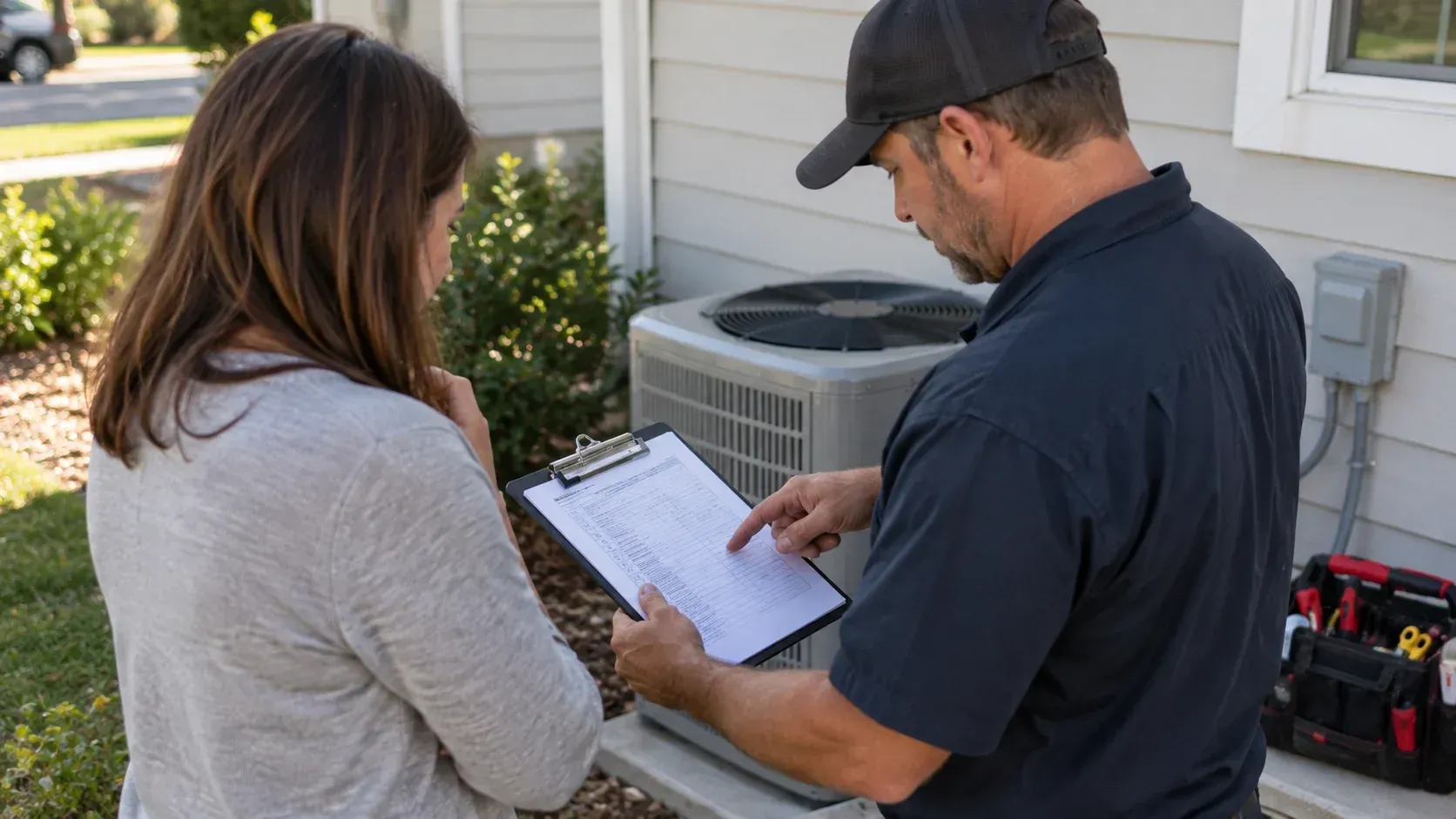
Do not assume the installer registered it. Some contractors handle registration as a matter of course. Many do not, and some intend to and it falls through. This is worth verifying rather than assuming, and it is verifiable.
What you need to register: the model and serial number of each piece of equipment, the installation date, and your details. The serial numbers are on the data plates on the equipment itself, and they should also appear on your installation paperwork.
How to check whether it was done: call the manufacturer's consumer line with your serial numbers, or ask your installing contractor for the registration confirmation. If neither can confirm it and you are still inside the window, register it yourself today.
If the window has closed, it is still worth calling. Some manufacturers will accept late registration in certain circumstances, particularly if the equipment was installed recently. It is a short call with a large potential payoff.
Register every component. A system typically includes an outdoor unit, an indoor unit, and possibly a furnace or air handler. Each has its own serial number and each needs registering.
Parts Are Covered, the Bill Is Not
The second expensive misunderstanding, and the reason people feel misled even when nothing went wrong.
A manufacturer parts warranty covers the part. It does not cover:
- Labor to diagnose, remove, and install it
- Refrigerant, which is excluded from essentially every manufacturer warranty even when the failed component is covered
- Refrigerant recovery and evacuation, which is required work on any sealed system repair
- Brazing materials, driers, and other consumables replaced during the repair
- The diagnostic visit that established what failed
- Overtime or emergency rates if you call on a weekend
What that looks like in practice. A compressor fails in year six on a registered ten year warranty. The compressor arrives at no cost. The invoice covers several hours of skilled labor, recovery of the existing refrigerant, a new filter drier, a full refrigerant charge, evacuation, and the diagnostic. On a large system that total can be substantial, and it is entirely legitimate.
This is what a labor warranty or extended plan is actually for. The parts coverage is generally the easy part to obtain. Labor coverage is the part that determines whether a major failure is an inconvenience or an expense.
Worth asking your installer directly: how long does your labor warranty run, what does it cover, and what would it cost to extend it. Ask before you need it, ideally at installation.
What Is Actually Covered
Typical inclusions on a manufacturer parts warranty:
- Compressor, often with a longer dedicated term than other parts
- Heat exchanger on a furnace, frequently with an extended or lifetime term
- Coils, both indoor and outdoor
- Blower motors and fan motors
- Control boards and electrical components
- Valves, sensors, and internal mechanical parts
Terms vary by component, which surprises people. A system might carry ten years on parts generally, ten or twelve on the compressor, and twenty or lifetime on the heat exchanger. Read the actual document rather than assuming one number applies to everything.
Terms also vary by equipment tier. Higher end models sometimes carry longer coverage than entry level equipment from the same manufacturer.
What Is Never Covered
Consumables and maintenance items. Filters, belts, fuses, batteries, and anything you are expected to replace routinely.
Refrigerant, as covered above.
Labor, unless you hold a separate labor warranty or extended plan.
Maintenance itself. Tune ups, cleaning, and inspections are your cost, and they are also a condition of coverage.
Damage from lack of maintenance. A compressor that failed because the condenser coil was never cleaned is a maintenance failure rather than a defect, and manufacturers do deny on this basis. There are predictable consequences to putting off HVAC repairs and service, and warranty denial is one of the more expensive ones.
Damage from external causes. Lightning, flooding, power surges, hail, vermin, and storm damage. These belong to your insurer.
Damage from improper installation. Which is a warranty issue with the installer, not the manufacturer.
Ductwork. Almost never included in equipment warranty, even though duct problems cause a large share of comfort complaints.
Consequential damage. Water damage from a blocked condensate drain, for instance, is typically excluded even where the failed component is covered.
Systems moved from their original installation address, or used commercially when rated residential.
What Voids Coverage
Failure to register. Not technically a void, but the practical effect is losing half the term.
Undocumented or absent maintenance. The most common basis for denial. Most manufacturers require annual professional maintenance and the ability to prove it.
Installation or repair by an unlicensed contractor. In Alabama, HVAC contractors are licensed through the state board, and the certification is verifiable. Work performed by someone without the appropriate license can jeopardise coverage in addition to the other risks it carries. Ask for the certification number before work begins.
Do it yourself repairs on the sealed system. Anything involving refrigerant requires certification to perform legally, and the homeowner attempts void coverage on the components involved.
Non OEM replacement parts. Substituting a generic part can void coverage on related components, not just the part itself.
Improper sizing. A system installed without a proper load calculation, or oversized to be safe, can fall outside the manufacturer's installation requirements. Oversized equipment also short cycles, which shortens component life and produces the failures you then try to claim on.
Mismatched components, covered next.
Modifications. Altering the equipment or its controls outside the manufacturer's specifications.
Failure to correct a known problem. Continuing to run a system a technician has told you needs attention transfers responsibility for what happens next.
Matched Systems and the Half Replacement Problem
This one costs real money and comes up constantly, particularly when an outdoor unit fails on an older system.
Manufacturers generally require matched, certified equipment combinations for full warranty coverage and for the rated efficiency to apply. The outdoor unit, indoor coil, and air handler or furnace are engineered and tested as a set.
Replacing only the outdoor unit on an older system is tempting because it appears to halve the cost. What it produces is a combination that was never tested together, which can mean reduced or voided warranty coverage on the new equipment, efficiency well below the rating on the box, and a system that never quite performs.
It also puts new equipment against an old indoor coil, which is frequently where the next failure comes from.
When half replacement is genuinely reasonable: an outdoor unit failing early in the life of a system where the indoor equipment is a compatible current model. That is a narrower set of circumstances than it is usually applied to.
Ask directly whether a proposed combination is a certified matched pair and what warranty terms apply to it. Get the answer in writing. This is one of the decisions where the cheaper quote is often the more expensive choice, and it is worth understanding alongside the broader question of when a system should be repaired rather than replaced.
Documentation That Holds Up to a Claim
Manufacturers can and do request maintenance records. What you have on file determines whether a claim proceeds.
What actually supports a claim:
- Dated invoices from a licensed contractor showing the work performed
- Line item detail describing what was inspected, cleaned, tested, and measured
- Equipment identification, meaning model and serial numbers on the paperwork
- Continuity, meaning a record for each year rather than one visit five years ago
What does not support a claim: an invoice reading service call with a dollar amount and nothing else. That documents that someone came, not that maintenance was performed. Ask your contractor for itemised maintenance invoices, and check that the equipment details appear on them.
Build a warranty file and keep it in one place, ideally digital and backed up:
- Original installation contract and equipment invoice
- Model and serial numbers for every component
- Registration confirmation
- The full warranty document, not the marketing summary
- Every maintenance invoice
- Every repair invoice, including parts used
- Your contractor's license or certification number
Photograph the data plates on each piece of equipment when the system is installed. Serial numbers become unreadable over time, particularly on outdoor units, and a photograph taken on day one saves a scramble in year eight.
Transferring Coverage When You Sell
Frequently overlooked and worth real money at closing.
Many manufacturer warranties are transferable to a subsequent homeowner, and many are not. Where they are, transfer usually comes with conditions:
- A short notification window, often thirty to ninety days after the sale
- A transfer fee in some cases
- A reduced term in some cases, where the transferred warranty reverts to the base period rather than the registered extended one
Why it matters to a seller. Transferable coverage on a recent system is a genuine selling point, and it is worth documenting in the listing.
Why it matters to a buyer. If you are buying a home with a system installed a few years ago, ask for the warranty documentation and the serial numbers, and find out what the transfer requires. Doing it during the transaction is far easier than reconstructing it a year later.
Contractor labor warranties are often not transferable at all, since they are an agreement with the original customer.
How a Claim Actually Works
1. Do not attempt a repair. Any DIY intervention on a failing system risks the claim.
2. Note the symptoms. What it is doing, when it started, whether anything preceded it, any error codes on the thermostat or equipment. This speeds diagnosis.
3. Call a licensed contractor. Ideally one authorised to service your brand, since manufacturers sometimes require it and since the contractor generally files on your behalf.
4. Expect to pay for the diagnosis. Establishing what failed is your cost in almost every case.
5. The contractor verifies coverage using the serial number, checking the term, the registration status, and whether the component is covered.
6. The part is ordered against the warranty. Timing depends on availability, and on older equipment a part may be obsolete, in which case a like for like substitute is usually supplied.
7. You pay the non covered portion. Labor, refrigerant, consumables.
Ask for the coverage determination in writing before the work starts. Verbal assurance that something is covered is not something to rely on for a large repair.
When You Are Told It Is Not Covered
Denials happen, and some of them are worth challenging.
Ask for the specific reason in writing, citing the provision relied on.
Check the reason against your documentation. Denials for undocumented maintenance sometimes resolve when the records are produced.
Verify the registration status independently, since a denial based on term length may rest on the assumption that the equipment was never registered.
Confirm the failure diagnosis. A denial resting on cause, such as attributing a failure to lack of maintenance, is a judgment call. A second opinion from another licensed contractor is reasonable on a large repair.
Contact the manufacturer directly. Consumer relations sometimes reaches a different conclusion than a dealer, particularly where documentation was incomplete initially.
Check whether it belongs to a different policy. A denial from the manufacturer occasionally means the cause was external, which points to your insurer instead.
Weigh the effort against the amount. For a small part it is rarely worth extended argument. For a compressor it usually is.
Extended Warranties and Home Warranty Companies
Two different products, both worth evaluating on their own terms.
Extended warranties and labor plans attached to your specific equipment tend to be the more straightforward proposition. What to weigh:
- Whether labor is included. This is usually where the value is, since parts coverage is often already long.
- The cost against a realistic repair. Compare the plan price over its term against what one significant repair would cost.
- How long you plan to stay in the home.
- The age of the system. Coverage bought at installation is generally cheaper and broader than coverage added later.
- Whether it duplicates coverage you already hold.
Home warranty companies operate differently and deserve more scrutiny:
- You do not choose the contractor. They assign one from their network.
- Service fees apply per visit, on top of the annual cost.
- Annual and per item caps may fall well short of a full system replacement.
- Exclusions are extensive, commonly covering pre existing conditions, improper prior maintenance, and code upgrades required during the repair.
- Replacement is often like for like at their discretion rather than an upgrade to current equipment.
Neither is inherently good or bad. Both are worth reading in full before purchase rather than after a denial.
What Alabama's Climate Does to the Math
Local conditions change how warranty coverage should be thought about, even though the terms are national.
A long cooling season means more runtime hours. A ten year warranty covers a fixed number of years, not a fixed number of operating hours. Equipment running from spring into autumn accumulates far more wear in ten years than the same equipment in a short season climate. The practical effect is that coverage should be treated as more likely to be needed, not less.
Heat pumps run in both seasons, which is common across north Alabama, and that compounds the runtime point. There is no idle half of the year.
Humidity increases the load on the system and makes condensate management a routine concern rather than an occasional one. Blocked condensate drains cause water damage that is typically excluded from equipment warranty coverage, which makes drain maintenance disproportionately valuable.
Coil corrosion is a real failure mode in humid conditions, and coils are a component where warranty terms are worth knowing precisely.
Maintenance timing. In a long cooling season, a single annual visit in spring leaves the system unchecked through its heaviest period. Semi annual service, in spring and autumn, both suits the climate and satisfies manufacturer requirements comfortably.
On new installations, getting the sizing and the ductwork right matters more where the system runs constantly, and it is also a warranty condition. A proper load calculation before HVAC installation protects both the performance and the coverage.
Conclusion
Two actions protect most of the value in an HVAC warranty. Confirm the equipment was registered within the manufacturer's window, since unregistered systems commonly revert from ten years of parts coverage to five, and do not assume the installer handled it. Then keep itemised annual maintenance invoices from a licensed contractor, because undocumented maintenance is the most common reason claims are denied.
Beyond that, set expectations correctly. A parts warranty covers the part. Labor, refrigerant, recovery, and the diagnostic are yours unless you hold a separate labor plan, which is why a covered compressor still produces an invoice. Knowing that in advance is the difference between an expected cost and feeling misled.
And know which of the five coverages applies before you make the call. Mechanical failure is a warranty question. Storm, lightning, and hail damage is an insurance question. Getting that wrong wastes time on the phone and, occasionally, the claim itself.
Protect What You Have Already Paid For
If you are not certain whether your system was registered, when your coverage runs out, or whether your maintenance records would support a claim, those are quick things to establish and worth knowing before something fails. We can pull the details from your serial numbers, tell you where your coverage stands, and set up maintenance that satisfies your manufacturer's requirements. You can get in touch through our contact page or call (256) 572-9630.
Serving Guntersville, Albertville, Boaz, Horton, Fort Payne, and Blount County.
Frequently Asked Questions
What is covered under an HVAC warranty?
Manufacturer warranties cover defective parts such as compressors, coils, heat exchangers, motors, and control boards. Labor, refrigerant, filters, and maintenance are not included. Terms vary by component, so read the actual document.
How do I keep my HVAC warranty valid?
Register the equipment within sixty to ninety days of installation, have it professionally maintained every year, and keep itemised invoices showing what was done. Use licensed contractors and manufacturer approved parts for any repair.
What voids an HVAC warranty?
Skipping registration, missing or undocumented maintenance, unlicensed installation or repair, non OEM parts, improper sizing, and mismatched components. Do it yourself work on the sealed refrigerant system voids coverage on the parts involved.
Is an extended HVAC warranty worth it?
It depends on whether it includes labor, since parts coverage is often already long. Compare the plan cost against one major repair, and factor in how long you plan to stay. Buying at installation is usually cheaper than adding it later.
Does homeowners insurance cover HVAC replacement?
Only for sudden accidental damage such as lightning, fire, hail, or a fallen tree. Mechanical breakdown and wear are never covered, though some carriers sell an equipment breakdown endorsement separately.
Related Posts